Yes, you can tow an automatic car — but how it is towed decides whether the gearbox survives the trip. South African law lets a friend tow you on a rope or chain only if the gap between the cars is no more than 3.5 metres and you stay at or below 30 km/h, with a licensed driver steering the towed car.[1] Car makers are often stricter than the law: one of Kia's 2026 owner's manuals limits a four-wheels-down tow of an automatic to 15 km/h and less than 1.5 km, and a Toyota manual says never to tow its automatic from the rear with the front wheels on the ground.[3][4]
- Regulation 330 of the National Road Traffic Regulations caps a rope, chain or tow-bar at 3.5 metres between the two vehicles
- On a rope or chain, the legal limit is 30 km/h — only a drawbar or tow-bar allows more
- Someone with the right licence must steer the towed car, unless its steering wheels are lifted clear of the road
- Owner's manuals for automatics can be much stricter than the law (Kia: 15 km/h, under 1.5 km, front only, in neutral)
- Kia's manual says all-wheel drive or a transmission fluid leak means flatbed or wheel dollies, not wheels on the road
What SA Law Says About Towing a Car With a Rope
Towing on a public road is covered by regulation 330 of the National Road Traffic Regulations, 2000, made under the National Road Traffic Act. It opens with “No person shall operate a vehicle on a public road towing another vehicle” and then lists the situations where you may not.[1] The 3.5-metre rule has been in the regulation since it was first published in the Government Gazette in March 2000.[2] Here is what each rule means for a driver whose automatic has just died on a Pretoria road:
| Reg 330 | The rule | What it means for you |
|---|---|---|
| (a) | Tow-rope, chain or tow-bar no longer than three and a half metres | A long recovery strap that leaves a big gap is not legal on a public road |
| (b) | Both vehicles must be under control | A slack rope that lets the towed car run into the one in front breaks this rule |
| (c) | A person with the right driving licence code must steer the towed vehicle — unless its steerable wheels are carried clear of the ground | On a rope, someone licensed sits behind the wheel of your car. On a truck that lifts the front wheels, nobody needs to |
| (e) | No more than 30 km/h unless joined by a drawbar or tow-bar | A rope or chain tow is a crawl, not a trip down the highway |
| (f) | No more than 30 km/h if the towed vehicle is carrying people (semi-trailers excepted) | Even on a tow-bar, passengers in the towed car keep it to 30 km/h |
| (g) | The towing vehicle may not be a motorcycle, motor tricycle, quad or pedal cycle | A bike can't tow a car, however short the distance |
Notice what the law does not say: nothing in regulation 330 is about automatic gearboxes. The law only tells you how to tow safely on the road. Whether your gearbox can take it is the car maker's question — and their answer is usually stricter.
What Car Makers Say About Towing Automatics
We read the towing sections of two manufacturers' owner's manuals rather than repeating forum advice. The wording differs, but the warnings point the same way:
- Kia (2026 online owner's manual, US edition): “The use of wheel dollies (1) or flatbed is recommended.” If an automatic is towed with all four wheels on the ground, “it can be towed only from the front” and must be in neutral, and the manual says to “limit the vehicle speed to 10 mph (15 km/h) and drive less than 1 mile (1.5 km) when towing.”[3]
- Kia, on all-wheel drive: “The AWD vehicle should never be towed with the wheels on the ground. This can cause serious damage to the transmission or the AWD system.”[3]
- Kia, on leaks: “If the transmission fluid is leaking, flatbed equipment or a towing dolly must be used.”[3]
- Toyota (owner's manual OM12C16U, published by Toyota Canada): for the automatic, “Never tow this vehicle from the rear with the front wheels on the ground,” and when a wheel-lift truck tows from the rear, “Use a towing dolly under the front wheels.” The same manual says the car “is not designed to be dinghy towed (with 4 wheels on the ground)” behind a motorhome, and allows a cable or chain tow only as an emergency measure, “on hard surfaced roads for short distances at low speeds.”[4]
Put that next to the law and the gap is obvious: a rope tow at the legal 30 km/h is already double the 15 km/h that Kia's manual allows for an automatic on its own wheels. These are the rules for specific models, so your own owner's manual is the final word. Look for the “Towing” section, usually in the emergency chapter.
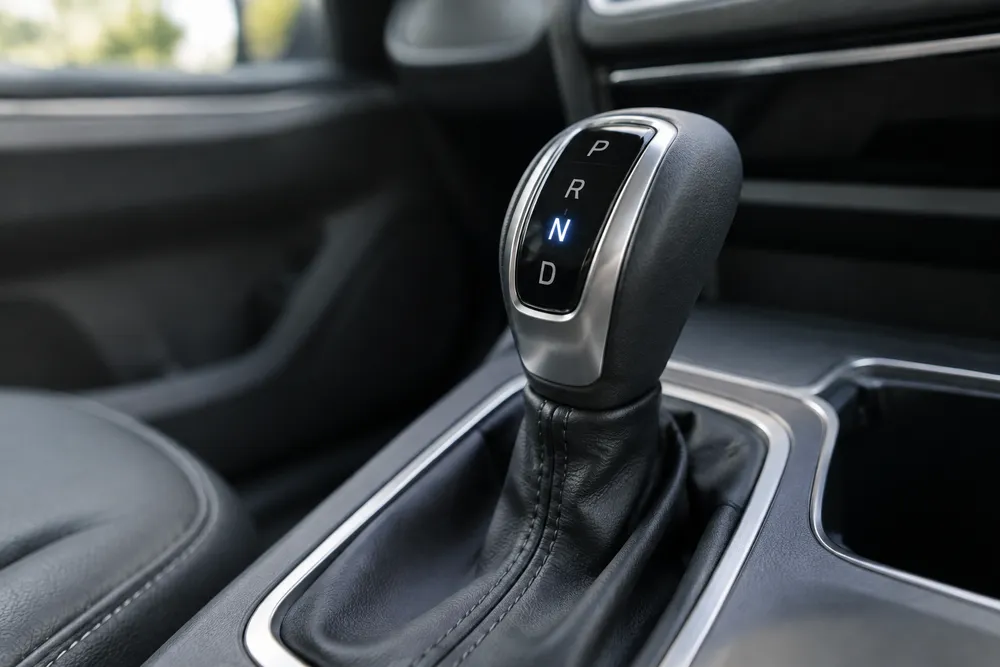
Which Towing Method for Your Automatic?
We built this table from the regulation and the two manuals above. It doesn't replace your own manual, but it covers the common situations:
| Your situation | Safest option | Why |
|---|---|---|
| All-wheel-drive automatic | Flatbed | Kia: AWD “should never be towed with the wheels on the ground” |
| Transmission fluid leaking | Flatbed or wheel dollies | Kia: flatbed or dolly “must be used” |
| Engine runs but the car won't move in gear | Get advice first, then a flatbed is the safe choice | Toyota lists this as a possible transmission problem: “Contact your Toyota dealer before towing” |
| Front-wheel-drive automatic, wheel-lift truck | Lift the front (driven) wheels — or use a dolly if towing from the rear | Kia: on two wheels, “lift the driven wheels off the ground”. Toyota: never from the rear with the front wheels down |
| A friend offers a rope or chain | Only off the road or a very short hop, if your manual allows it | Law: 3.5 m and 30 km/h. Kia: 15 km/h, under 1.5 km, from the front only |
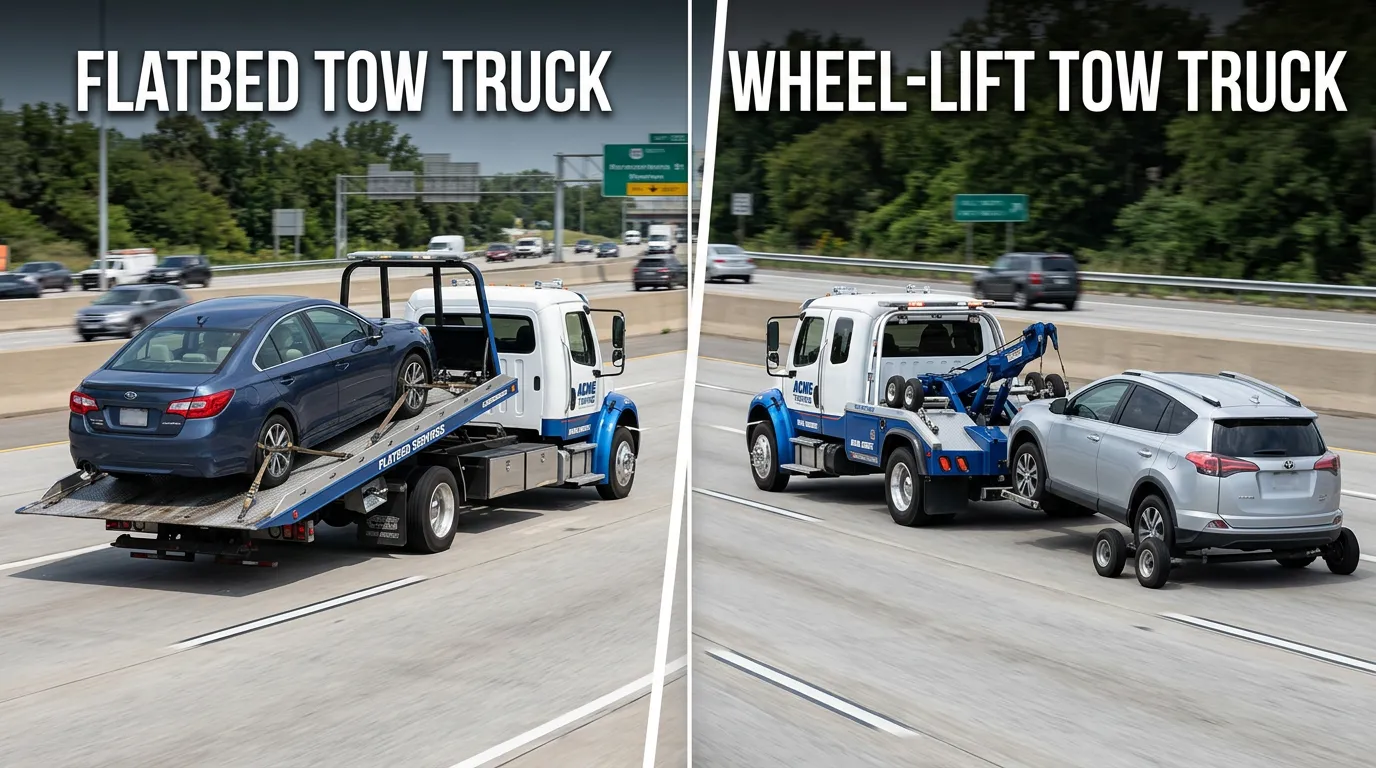
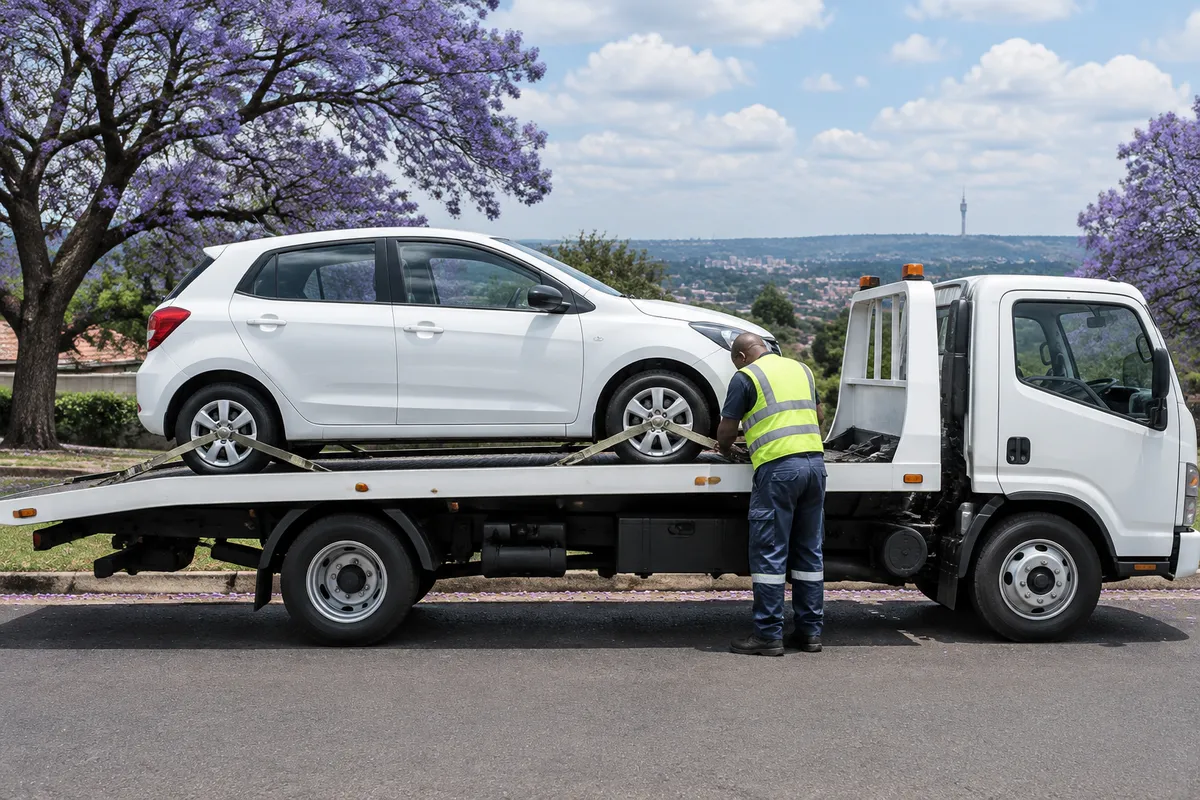
For the difference between the two truck types, see our guide to flatbed vs wheel-lift towing. If you're not sure what drives your car's wheels, ask for a flatbed tow in Pretoria — your car rides on the truck, so its gearbox never turns.
Before Anyone Tows Your Automatic
If a wheels-down tow is the only option, the manuals spell out the basics:
- Check under the car for fluid. A transmission leak rules out any tow on its own wheels.[3]
- Ignition to ACC, selector to N, parking brake off. Kia warns that “Failure to shift to N (Neutral) may cause internal damage to the vehicle.”[3]
- Put a driver in the towed car. Kia's manual requires one “to operate the steering and brakes”, and on a rope the law requires a licensed driver at the wheel.[1][3]
- Expect heavy steering and brakes. Toyota notes that with the engine off, “the power assist for the brakes and steering will not function”.[4]
- No sling-type tow trucks. Both manuals rule them out: Kia says to use wheel lift or flatbed equipment instead.[3][4]
Want a rough figure before you call? Our towing cost calculator estimates by distance and vehicle, and our Pretoria towing price guide explains what pushes a quote up.
Automatic Won't Move? Don't Risk the Gearbox.
Tell us the make and model and we'll send the right truck to get it to your mechanic in one piece. Pretoria, Centurion & Midrand, 24/7.
Get a Tow in PretoriaFrequently Asked Questions
How far can you tow an automatic car?
It depends on the model, so check your owner's manual. With all four wheels on the ground, one of Kia's 2026 manuals allows less than 1.5 km at no more than 15 km/h, towed from the front in neutral. A Toyota manual we checked allows a cable or chain tow only in an emergency, on hard surfaced roads, for short distances at low speeds. On a flatbed there is no such limit, because the wheels never turn.
Can I tow an automatic car in neutral?
Neutral is required, but it isn't enough on its own. Kia's manual says failing to shift to neutral may cause internal damage, and even in neutral it limits a wheels-down tow to 15 km/h and under 1.5 km. Neutral makes a short emergency move possible; it doesn't make a long tow safe.
Will towing damage an automatic transmission?
It can, if the driven wheels are on the road. Toyota's manual says never to tow its automatic from the rear with the front wheels on the ground, to prevent serious damage to the transmission. Kia's says an AWD vehicle should never be towed with the wheels on the ground. A flatbed avoids the risk because the car rides on the truck.
Is it legal to tow a car with a rope in South Africa?
Yes, within regulation 330 of the National Road Traffic Regulations: the rope or chain may be no longer than 3.5 metres, both vehicles must stay under control, a person with the right licence must steer the towed car, and you may not exceed 30 km/h unless the cars are joined by a drawbar or tow-bar. A motorcycle may not be the towing vehicle.
How do you tow an automatic car that won't start?
The safest way is a flatbed, or a wheel-lift that raises the driven wheels. If the engine runs but the car won't move, Toyota treats that as a possible transmission problem and says to contact the dealer before towing, so we'd keep its wheels off the road. Tell the tow operator the make, model and whether it is all-wheel drive when you call.
Sources
- National Road Traffic Regulations, 2000, regulation 330 “Towing of vehicles” (consolidated text, read 22 November 2026). Acts Online
- Government Gazette No. 20963, Regulation Gazette, 17 March 2000 — National Road Traffic Regulations as first published. Gazettes.Africa archive (PDF)
- Kia owner's manual (2026, US English, online edition): “Towing service”, “When flatbed is unavailable” and “Towing without wheel dollies when using a towing service”. ownersmanual.kia.com
- Toyota owner's manual OM12C16U (Toyota Canada): “If your vehicle needs to be towed” and “Dinghy towing (automatic transmission)”. toyota.ca (PDF)